Chapter 2: How AI Learns & Makes Decisions
Data Shapes What AI Learns
Data Shapes What AI Learns
AI models learn from data, but that data is not a neutral or complete representation of the world. It reflects the information that was available to collect, the choices people made about what to include, and sometimes, what was left out. These choices can shape what an AI system learns, what it recognizes, and how it responds.
Not every AI system learns from the same kind or amount of data. The data needed depends on what the system is designed to do. One model might learn from images, another from text, and another from measurements or observations. Some systems also require far more training data than others. What matters is not simply how much data a system has, but whether that data is appropriate for what the system is being asked to do.
Think of a machine learning model like a student who has only been given history books written from a single perspective. When it comes time to write a report, that student can only draw from the information they have encountered. Their understanding may be detailed in some areas while missing important voices, experiences, or perspectives altogether.
Something similar can happen with AI. If certain groups, experiences, or perspectives are missing or underrepresented in the data used to train a model, the system may struggle to account for them. If the data contains errors or reflects existing biases, those patterns can also show up in the model’s outputs. An output is the result produced by an AI system after it receives an input. This could be a prediction, classification, recommendation, generated response, image, or another type of result.
The example above shows why the data behind an AI system can matter. Before we look more closely at where that data comes from and what it might leave out, it helps to understand a few terms that will come up throughout this topic.
This is why the data behind an AI system matters so much. It doesn’t simply give the model information to learn from. It helps shape what the system can recognize, what it may miss, and how it responds to the world.
Where Does the Data Come From?
We know that AI systems learn from data, but where does all of that data actually come from?
There isn’t one answer. The source depends on the type of AI system, what it is designed to do, and how it was developed. Training data can include text, images, audio, video, measurements, records, and many other forms of information. It can also come from many different places (CloudHop, 2025; OpenAI, 2026).
Here are a few common sources:
Publicly available information
Some AI models learn from information that is publicly accessible online. This might include webpages, blogs, public forums, public posts, images, or other openly available material. AI models used in popular chat tools may learn from enormous collections of this kind of information.
Curated or purpose-built datasets
Sometimes data is deliberately collected and organized for a particular purpose. For example, a dataset designed to help an AI system recognize objects might contain thousands of images that have been labelled according to what appears in them.
Organizational or specialized data
Organizations can also use their own data to develop AI for specific purposes. Depending on the context, this could include historical records, customer interactions, product images, sensor readings, medical images, or other specialized information.
Human-created or labelled data
People play an important role in preparing data for AI. Human contributors might label images, categorize information, write examples, or evaluate and correct responses. This helps provide the system with information it can learn from or use during different stages of development.
In supervised learning, people may label examples so the model has correct answers to learn from. In unsupervised learning, the data doesn't come with those predefined labels. Either way, the data the model has access to shapes the patterns it is able to learn.
Synthetic data
Not all training examples come directly from the real world. Synthetic data is artificially generated information created to supplement other data. It can be useful when real-world examples are limited or when developers want additional examples of particular situations.
Match the Data to Its Source
The Choices Behind the Data
Every dataset has a history. People make choices about what information is collected, selected, organized, labelled, and used to develop an AI system. This gives us some important questions to start asking: Who created the data? Who selected what was included? Who owns it or has permission to use it? Who is represented within it? And whose experiences or perspectives might be missing?
What Gets Represented (And What Doesn’t?)
Having a lot of training data does not necessarily mean that everyone or everything is represented equally. Some languages, regions, communities, perspectives, and experiences may appear frequently in a dataset, while others may be less common or missing altogether.
That matters because AI systems learn patterns from the examples available to them. If certain people, places, or situations are underrepresented, the system has fewer examples from which to learn about them. This is why it is important to consider not only how much data an AI system was trained on, but also what that data represents.
A dataset can be very large while still containing meaningful gaps. More data does not automatically mean more representative data.
What Could This Mean in Education?
Similar questions matter when AI is used to work with language, history, culture, and other forms of knowledge. UNESCO cautions that generative AI tends to reproduce common or dominant perspectives that appear frequently in its training data. Communities with a more limited digital presence may therefore be less represented in both the data and the resulting outputs (Miao & Holmes, 2023).
“Their voices are consequently not being heard and their concerns are not represented in the data being used to train GPTs, and so rarely appear in the outputs.”
For educators and students, this means it is worth asking not only “What does the system know?” but also “Whose knowledge and experiences might be missing?”
When Data Carries Bias
In the previous section, we explored what can happen when certain people, communities, or perspectives are underrepresented in training data. This is one example of representation bias. But representation is only one place where bias can emerge. Bias can also reflect historical patterns already present in data, choices made while a model is being developed, and the context in which an AI system is used.
This doesn't necessarily mean someone intentionally designed an unfair system. AI systems learn from information about our world and are shaped by human decisions along the way. This means that existing inequalities, gaps, assumptions, or design choices can influence what a system learns and how well it works for different people.
Where Does Bias Come From?
There isn't just one point where bias can enter an AI system. It can begin with patterns already present in the data, emerge through which examples are selected for a dataset, be introduced or reinforced during model training, or arise from how the finished system is eventually used. The diagram below follows this simplified path through an AI system. Explore each point to see where different forms of bias can come into play.
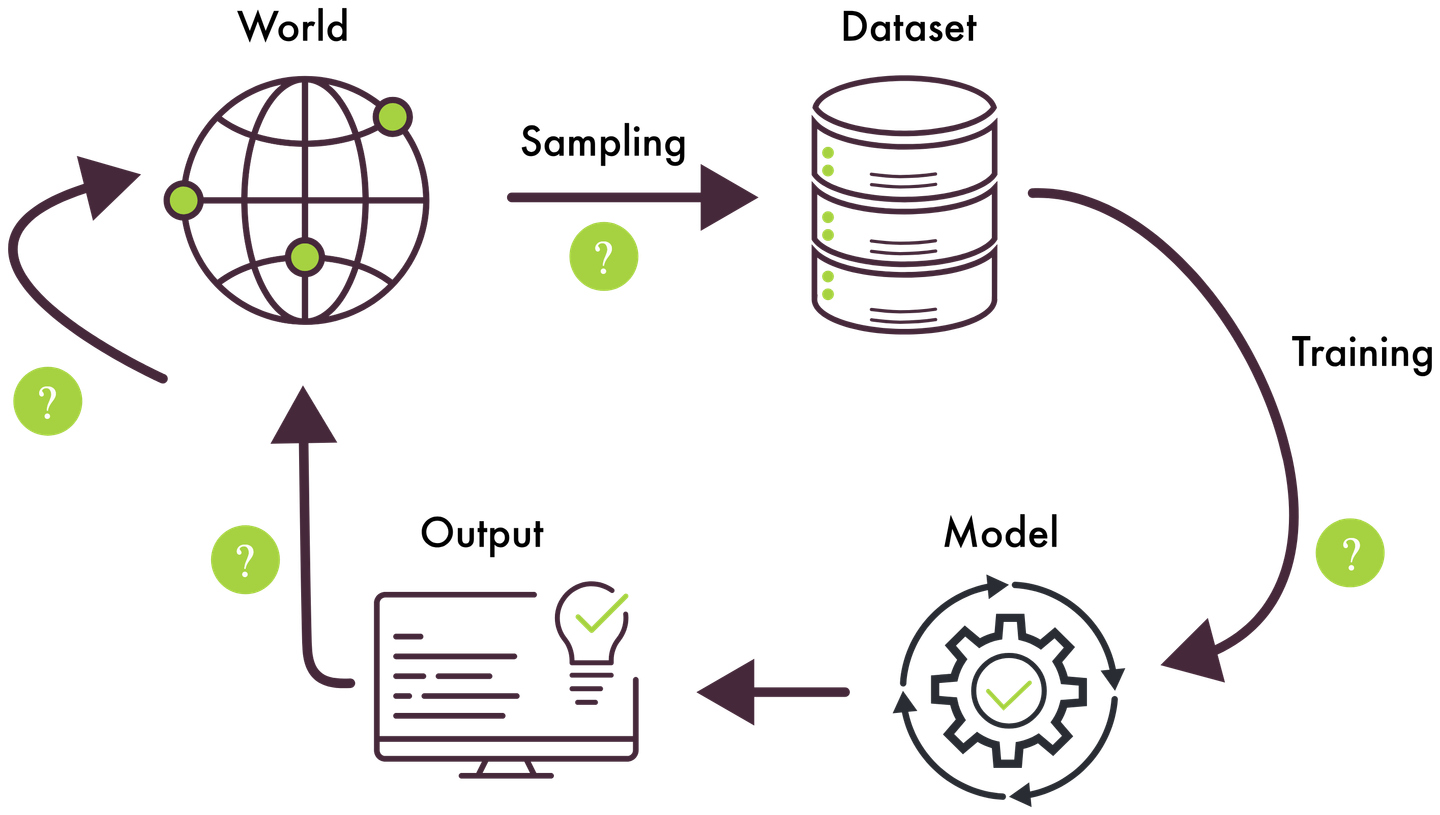
Historical Bias (the past)
What patterns from the past are reflected in the data?
Historical data can reflect existing inequalities, stereotypes, or social patterns. An AI system that learns from this information may also learn those patterns. One example could be an AI language system that learns associations between certain professions and genders from patterns that repeatedly appear in historical text.
Representation Bias (the input)
Who or what is well represented, and who might be missing?
Sampling is the process of choosing which examples are included in a dataset. If certain groups, communities, experiences, or perspectives appear less often in training data, the system has fewer examples from which to learn about them. One example could be an image-recognition system that is trained on many examples from some regions of the world but far fewer from others.
Learning Bias (the process)
What is the model being trained to prioritize?
How a model is trained matters too. Optimizing for one goal, such as overall accuracy, can sometimes come at the expense of other considerations, including how well the model performs for smaller or underrepresented groups. One example could be a model that is optimized primarily for overall accuracy, even though this results in poorer performance for a smaller group represented in the data.
Deployment Bias (the output/future)
Is the system being used in an appropriate context?
Even a well-designed system can create problems if it is used for a different purpose, population, or situation than the one it was designed and evaluated for. One example could be an AI system developed and tested for one purpose that is later used to inform a higher-stakes decision it wasn't designed to make.
Garbage In, Garbage Out
You may have heard the phrase “garbage in, garbage out.” This popular phrase captures the idea that the quality of what goes into a system can affect the quality of what comes out.
The same idea applies to AI. A model learns patterns from the data available to it, so errors, missing information, or data that isn't well suited to the task can affect what the model learns. And as we've already explored, having a lot of data doesn't necessarily mean having good data.
So, what makes data useful for AI?
When data is inaccurate:
Imagine an image-recognition system being trained to identify different tree species. If many of the images are labelled incorrectly, the model may learn the wrong associations and make more mistakes when identifying new trees.
When data is accurate:
Images are accurately labelled and checked for errors, giving the model more reliable examples to learn from.
Key idea: AI can learn from errors in its training data as well as from accurate information.
What about Outdated Information?
Relevant data also needs to be appropriate for the time and context in which an AI system is being used. For example, an AI model may have been trained on information collected before a recent policy change, scientific discovery, or world event.
Some AI tools can now search the web or connect to other sources of current information, while others rely primarily on information learned during training. Either way, an AI response shouldn't automatically be assumed to be current or correct. When up-to-date information matters, checking the response against a reliable source is an important part of using AI thoughtfully.
Data is Never the Whole Story
We've seen that data plays a major role in shaping what AI systems learn. What is included, who and what is represented, the quality of the information, and the choices made along the way can all influence what a system learns and produces.
But data never tells the whole story. Overlooking the social, cultural, historical, and human contexts surrounding data can have real-world consequences. AI systems may work less reliably for some groups, leave certain perspectives out of their responses, or produce information that is inaccurate or poorly suited to the situation in which it is being used.
For educators, AI literacy means bringing context and professional judgment to what an AI system provides. It also means helping students ask what might be missing, whose perspectives are represented, and whether an output makes sense within the context in which it is being used.