Chapter 2: How AI Learns & Makes Decisions
Meet the Model: Data, Patterns and Training
Meet the Model: Data, Patterns and Training
When we say that an AI model “learns,” we aren't talking about learning in the same way people learn. AI doesn’t build understanding through lived experience, curiosity, or relationships. Instead, machine learning systems are trained using data. By working through many examples, they can identify patterns and relationships that help them respond to new information.
Those patterns can be used in different ways. One model might learn whether an email is spam. Another might predict what movie you’re likely to enjoy next. A generative AI model might use patterns in language to generate a response to your prompt.
In this chapter, we’ll explore how that learning happens, how data shapes what AI learns, how models move from patterns to predictions, and what happens when those predictions begin to influence decisions.
AI is Hiding in Plain Sight
When we hear the term AI today, it’s easy to think first of generative AI chatbots. However, AI models are also built into many of the technologies we already use every day.
You likely encounter them daily, sometimes without realizing it.
These systems do different things, but they share an important idea: AI models use patterns in data to produce an output, such as a prediction, recommendation, classification, or response. AI isn’t always a standalone tool or something clearly labeled as “AI.” Many of us have been using technology powered by AI for years without even recognizing it.
Different Ways Machines Learn
In Chapter 1, we learned that machine learning is a way of training AI systems to learn patterns from data rather than relying only on fixed, pre-programmed rules (Think: a basic calculator following programmed rules). Those learned patterns are then used to make predictions and produce outputs. But models don’t all learn those patterns in the same way.
There are several common approaches to machine learning. Let’s look at three common ones: supervised learning, unsupervised learning, and reinforcement learning.
In supervised learning, a model learns from examples that have already been labelled with the correct answer.
Imagine training a model to recognize spam emails. During training, the model is shown many emails labelled spam, or not spam. It uses these examples to learn patterns that can help it classify new emails.
Which Type of Learning?
One Term, Many Models
Supervised, unsupervised, and reinforcement learning describe different ways a model can learn. These approaches don’t necessarily tell us what the model will do once it is trained. AI models can use the patterns they learn to perform different kinds of tasks.
What Can a Model Do?
What About Multimodal AI?
In Chapter 1, we explored multimodal AI, which can work across different types of information, such as text, images, audio, and video. These capabilities are becoming increasingly common. Many large language models, including those that power familiar AI chatbots and assistants, can now work across multiple modalities, allowing them to interpret an image, respond to spoken language, generate an image from text, or create audio.
AI models can learn in different ways and use what they learn for different kinds of tasks. Supervised, unsupervised, and reinforcement learning describe how models learn, while classifying, predicting, recommending, and generating describe what models can do.
Learning By Example
We’ve explored different ways AI models can learn and different kinds of tasks they can perform. Now let’s look more closely at what happens during training.
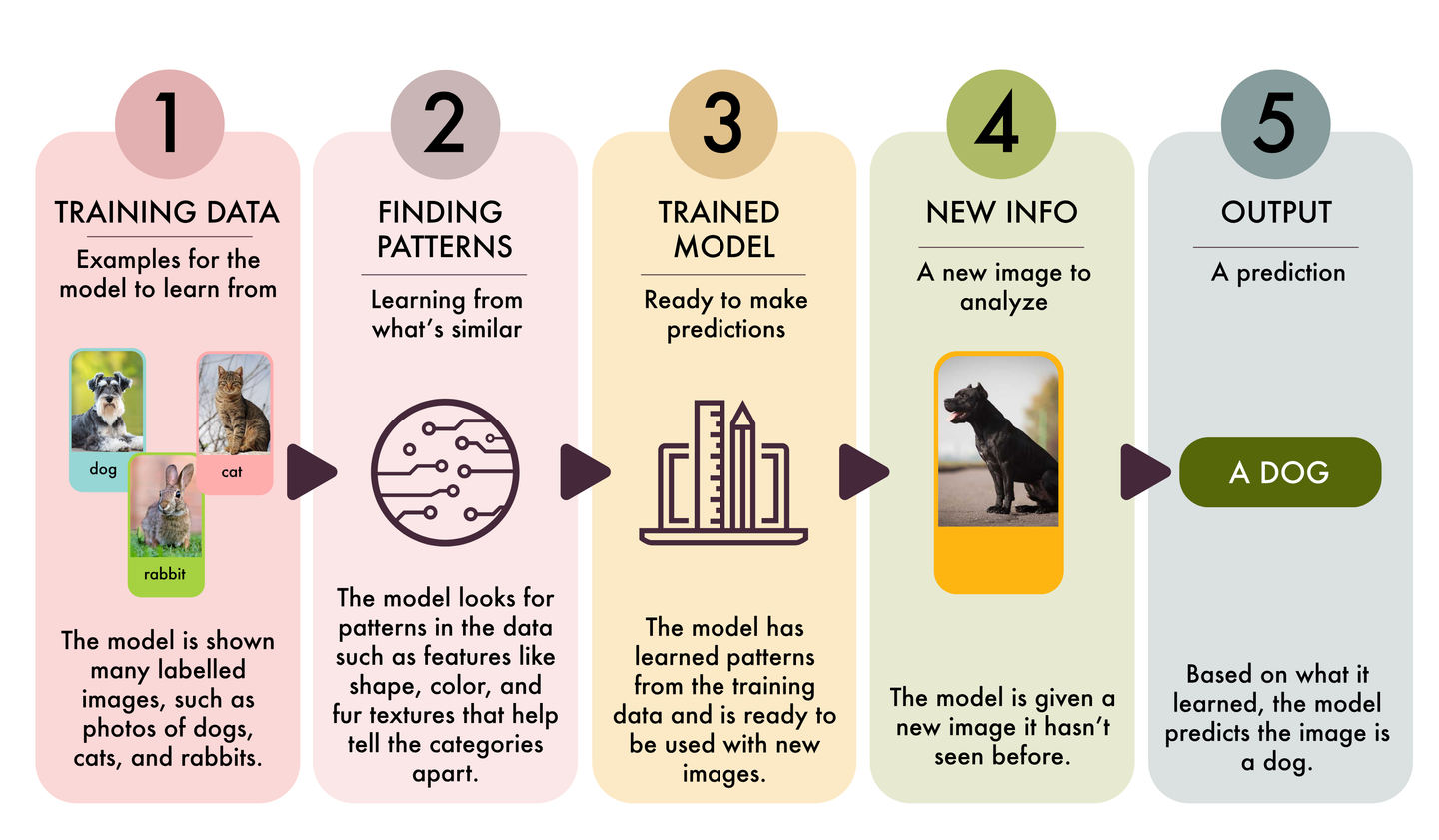
A model is trained using data. As it works through that data, it identifies patterns and relationships that can help it respond to new information later.
For example, a model trained to recognize dogs doesn’t need to have seen every possible dog. By learning patterns across many examples during training, it can use those patterns to recognize a new image it hasn't encountered before (Poole & Mackworth, 2023).
Let’s look at a simplified example of how this works.
Humans Learn, Machines “Learn”
We use the word learn for both people and machines, but they don’t learn in the same way.
People learn through experience, relationships, senses, instruction, reflection, and existing knowledge. Research on learning also shows us what we already know, along with the social, cultural, and physical contexts around us, shapes how we make sense of new information (National Academies of Sciences, Engineering, and Medicine [NASEM], 2018; Downes, 2023). We can connect new information to our understanding of the world, consider its meaning, and apply what we know in new situations.
When we say a machine learning model “learns,” we mean something different. During training, the model identifies mathematical patterns and relationships within data. Those learned patterns allow it to produce outputs when it encounters new information.
This distinction is very important. An AI model can become very good at a particular task without understanding that task in the way a person does. Understanding what we mean when we say AI “learns” gives us a foundation for the next question: What shapes the patterns a model learns in the first place?