Chapter 1: What is AI?
Defining Core Concepts
Welcome to AI for All: Essentials for Educators - powered by Amii.
Artificial Intelligence (AI) is no longer a far off, futuristic idea. It’s already here and actively reshaping our daily lives from how we work, communicate, create and learn. As AI becomes increasingly embedded in our everyday lives, students will encounter it in school and also in their future workplaces, communities and civic lives. As educators, helping students navigate this changing landscape means preparing them to understand AI, think critically about its role and impacts, and make thoughtful, ethical and creative choices about when and how to use it.
While all of the buzz around AI can make it feel complicated, or even overwhelming, understanding it doesn’t have to be. We want to help you move from, “What even is this technology?” to “Okay, I get it, and I can make informed choices about when and how to use it in my classroom and beyond.” Rather than thinking of AI as something we either need to embrace or completely avoid, our aim is to get curious about it and ask, what is AI actually capable of? What are its limitations? And when does collaborating with it make sense in education?
What is AI Literacy?
Today there are many definitions for the term AI Literacy, but globally-recognized frameworks offer a helpful starting point for us. UNESCO’s AI Literacy Competency Framework for Teachers (2024) frames AI literacy around the knowledge, skills, values, and attitudes needed to understand AI, critically evaluate it, and use it effectively and ethically, while maintaining human agency.
We can also look to the OECD/European Union’s Empowering Learners for the Age of AI: An AI Literacy Framework for Primary and Secondary Education (2026). Drawing on existing definitions from the EU AI Act (2024), OECD (2024), UNESCO (Miao & Cukurova, 2024; Miao et al., 2024), and others, the Framework defines AI literacy as “the technical knowledge, durable skills and future-ready attitudes required to thrive in a world influenced by AI. It enables learners to engage, create with, manage and shape AI, while critically evaluating its benefits, risks and ethical implications” (p. 5).
What’s important here is what is included in these definitions. AI literacy is not simply knowing how to use AI. It combines understanding with critical thinking, ethical judgement, and the ability to make intentional and informed choices about AI. In other words, being AI literate is not just about what you can do with AI, but how you think about it, our attitudes toward it, how we evaluate it, and decide when its use is appropriate.
Why AI Literacy is Essential for Educators
AI literacy is a responsibility shared by all educators. It enables you to make informed choices about technology rather than simply adopting it, and to consider whether AI tools have a place in your classroom, which tools are appropriate, how they can support teaching and learning, and where clear boundaries are needed.
It also helps educators model these skills for students. As learners encounter AI at school and in their everyday lives, they need more than the ability to use the tools. They need to know how to question what AI produces, recognize its limitations, understand that interacting with AI is different from interacting with another human, protect their information, and make thoughtful choices about when and how to use it.
Being AI literate doesn’t mean having all the answers about a technology that continues to evolve. Rather, it means having the knowledge and critical thinking skills to ask good questions, make informed decisions, and adapt as AI evolves and actively (re)shapes learning environments.
Understanding AI
Before we get too far into the technology that powers AI, let’s get a few key terms straight, starting with Artificial Intelligence (AI) itself.
AI might feel like a very hot topic of conversation right now, but the idea has actually been around for decades. Artificial Intelligence is a sub-discipline of computer science that dates back to 1955 when John McCarthy and his colleagues coined the term. Their work built on Alan Turing’s early work which helped lay the foundations of modern computing.
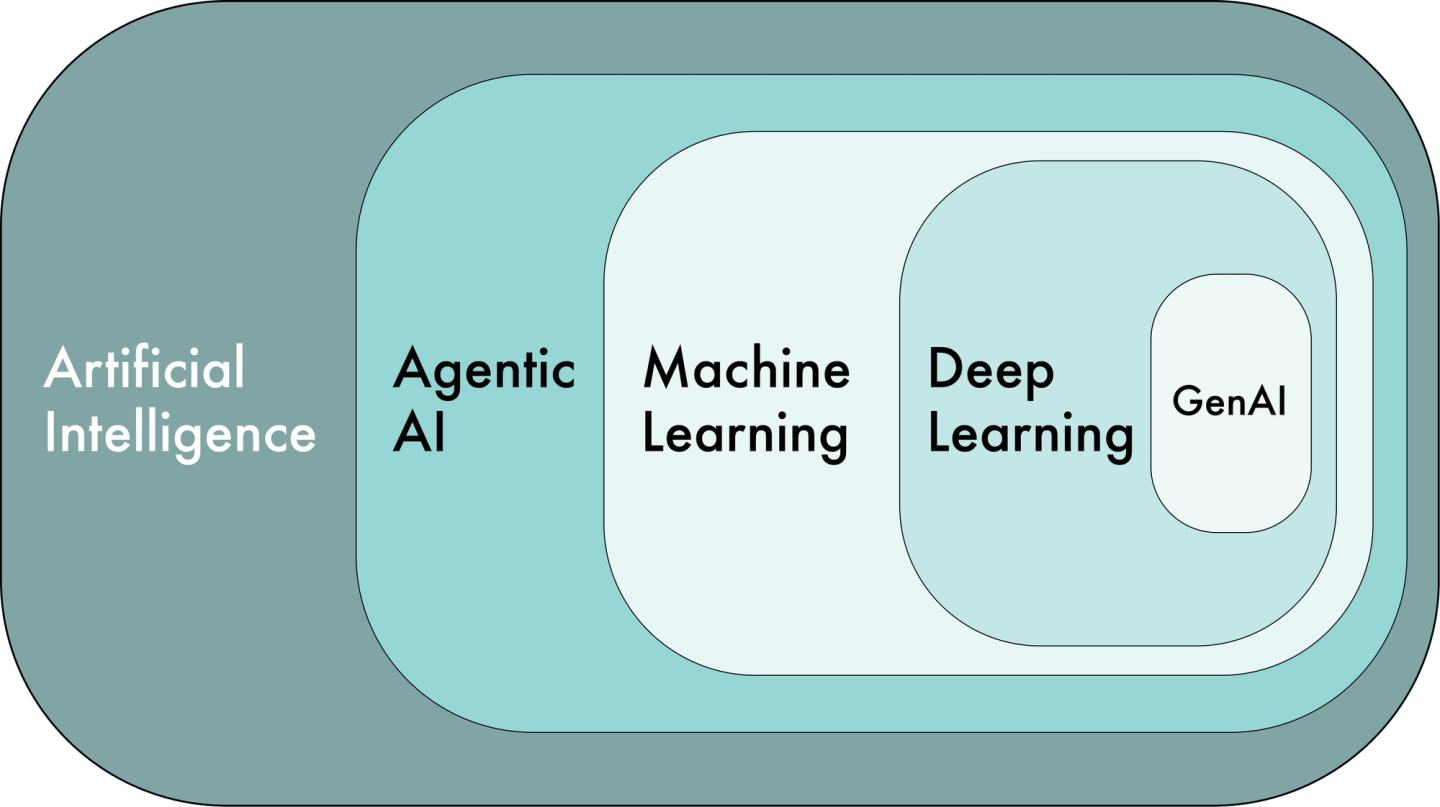
At its core, AI is the science of designing machines that can perform tasks we typically associate with human cognition. Those functions include reasoning, strategizing, recognizing patterns, and solving complex problems. So we can think of AI as an umbrella term. Underneath it are many different technologies, capabilities and approaches. Therefore knowing how they fit together will make the rest of the AI landscape much easier to navigate.
If AI is the umbrella term, let’s explore some other key terms that fall within it.
The diagram below introduces several terms you’re likely to encounter when learning about AI. While some represent technologies that build on one another, others describe what AI systems are designed to do. These relationships are evolving, so the diagram is intended as a simplified way to orient yourself to the field rather than a strict hierarchy.
Artificial Intelligence (AI)
At its core, AI is about building machines that can simulate human-like intelligence. This means tasks we typically think require human cognition – like understanding language, recognizing images, or even making complex decisions.
Agentic AI
AI that takes things a step further. Instead of waiting for you to tell it what to do at every step, agentic AI can work toward a goal with some independence. It can figure out the steps needed to complete a task, make decisions along the way, use different tools and sources of information, and adjust its approach when things change. This doesn’t mean it has complete freedom to act on its own. Agentic AI typically works within set boundaries and with human oversight, so people can guide, review or step in when needed (World Economic Forum, 2026).
Machine Learning (ML)
This is the primary way AI learns today. Instead of a programmer writing every single rule, we give the computer lots of historical data, and it learns patterns and creates its own rules from that data.
Deep Learning
As a more advanced subset of Machine Learning, Deep Learning algorithms are designed to mathematically mimic the human brain's structure using "artificial neurons," organized in hierarchical networks. These "neural networks" allow for even more complex pattern recognition and learning, especially with large amounts of data.
Generative AI
AI that goes beyond analyzing information and can create something new based on the material that it has been exposed to in the training process, like text, images, audio, video, or code, based on patterns it has learned.
Algorithms, Automation & Models
Three additional terms that are helpful to know are: algorithms, automation and models. They are closely connected, but describe different things.
An algorithm is a set of instructions a computer follows to complete a task or solve a problem. Algorithms are used throughout computing, not just in AI.
Automation is about making machines or systems do tasks automatically, following a set of pre-programmed, fixed rules. It replaces manual effort with a machine following exact instructions.
A model is a learned representation of patterns or relationships in data. In machine learning, a model is created through a training process and can then use what it has learned to make predictions, classifications, recommendations, or other outputs.
Imagine training an AI system to recognize whether an image contains a purebred or mixed-breed dog. Rather than writing instructions that describe every possible dog, the system can learn from many examples of correctly labelled images.
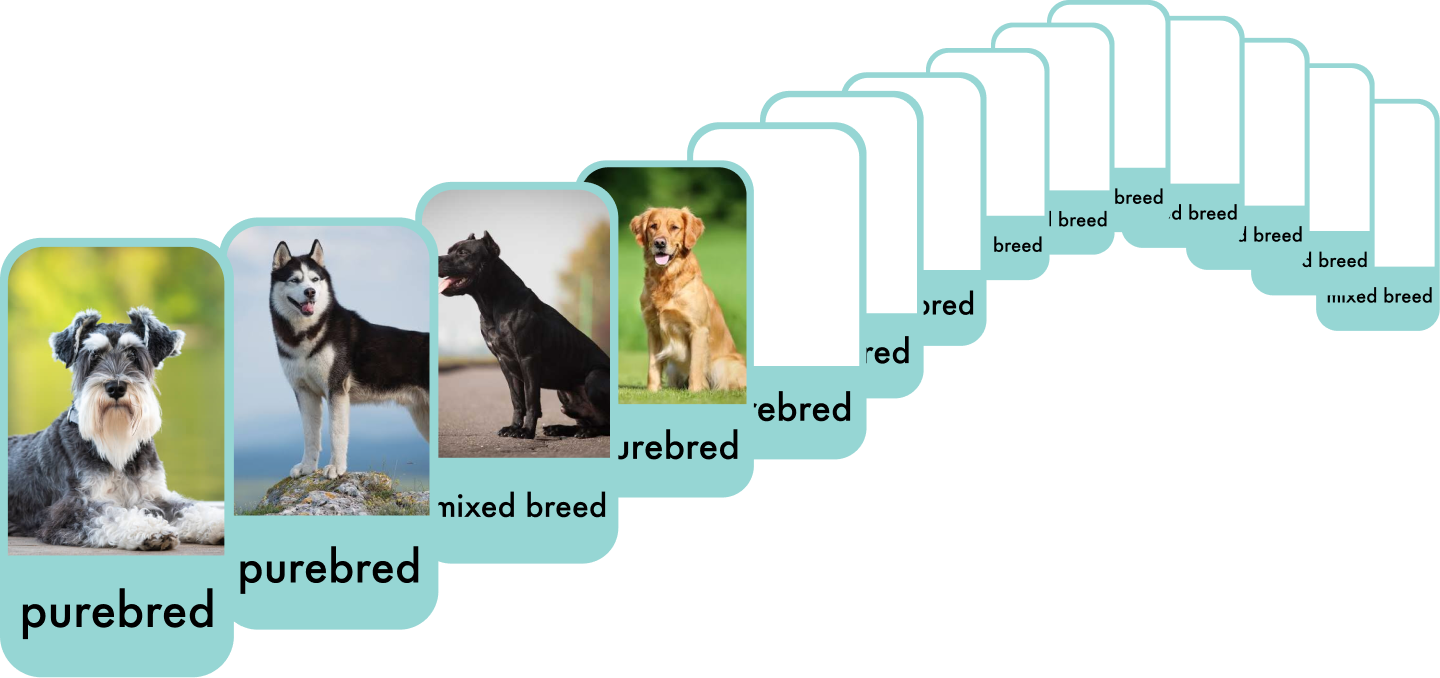
During training, machine learning algorithms help the model identify patterns in those examples. The trained model can then use what it learned to make a prediction about a new image it has never seen before.

The important idea is that data provides the examples, machine learning is the process of finding patterns in those examples, and the model is the result. The model can use what it has learned to make predictions or decisions about new data, while automation can use those outputs to trigger actions or carry out tasks automatically.
We will be exploring the ways in which machines learn from data in much greater detail in Chapter 2: How AI Learns and Makes Decisions.
What AI Does Well (And Not So Well)
AI is really good at spotting patterns. It doesn’t have a conscious mind, and it doesn’t “know” things quite in the same way humans do. Rather than programming a system with a rule for every possible situation, many AI systems learn from examples. They find patterns and relationships in data and use those patterns to make predictions or respond to something new.
Humans recognize patterns too. If you see:
January, February, March, __________
it’s unlikely you need to stop and work out the answer. You recognize what comes next.
AI doesn’t learn or reason the way a human brain does, but this example gives us a useful starting point. Depending on what an AI system is designed to do, it might analyze words, images, numbers, behaviours, weather data or other kinds of information. Then, what it learns can support many different capabilities. AI systems can use them to make predictions, work with language, organize information, and perform other tasks.
So what does that look like in practice? Here are a few things AI can do particularly well:
What AI Does Well
Where AI Reaches Its Limits
And don’t worry, we won’t leave you hanging! We’ll be taking a closer look at the conversation around AI-assisted assessment and plagiarism in Chapter 3: Risks and Realities.