Chapter 3: Risks and Realities
Academic Integrity & Copyright
Academic Integrity & Copyright
One of the first questions generative AI raised for many educators was fairly straightforward: Are students using it to cheat? It's an understandable concern. If an assignment is intended to demonstrate a student's writing, reasoning, or understanding, having AI complete that work can make it harder to understand what the student has learned.
But generative AI also makes academic integrity more complicated than a simple question of whether AI was used. A student might use AI to brainstorm possible topics, organize ideas, receive feedback on a draft, generate an image, translate text, or produce an entire response. The role AI plays can look very different from one task to another, and so can its implications for learning.
This creates new questions for educators and students. What role should AI play in a particular assignment? What learning should students be able to demonstrate? How can students be transparent about AI's contribution while still giving appropriate credit to the sources and materials they use? And how can educators keep students meaningfully connected to the work they submit?
Beyond Cheating and Detection
Earlier in this chapter, we explored some of the limitations of AI detection tools, including the risk of unfair results for students. If detection alone can't give us a clear picture of how a student completed their work, we need other ways to understand what they learned and how they contributed along the way.
Moving From the Product to the Process
For educators, paying attention to the learning process isn't new. Educators already use different opportunities throughout learning to see how students are developing their understanding. Drafts, discussions, feedback, practice activities, and check-ins can all provide valuable glimpses into learning as it happens, rather than relying only on a final assessment or project.
Generative AI gives educators another reason to pay attention to that process. When AI can contribute to different parts of an assignment, the final product may not always show what a student understood, decided, revised, or worked through themselves. Looking at parts of the process can help make the student's thinking and learning more visible.
Recent research describes this as process-oriented assessment, where evidence of how students develop their work is considered alongside what they ultimately produce. Decisions, revisions, reflections, mistakes, and changes in understanding can all provide meaningful evidence of learning (Winstone et al., 2026).
“Learning is not fully observed in polished final products.”
How Can We Make the Process Visible?
Research exploring academic integrity and assessment in the age of generative AI also suggests that educators can focus on selected moments in the learning process, rather than trying to document every step or every interaction with AI (Sharma, 2026). These small windows can help reveal students' reasoning and judgment while keeping the focus on meaningful evidence of learning.
Explore the examples below to see what this could look like in practice.
Students could explain a few meaningful choices they made while completing a task. If AI was involved, this might include explaining why they accepted, changed, or rejected an AI suggestion. The focus is on making the student's judgment and reasoning visible, rather than documenting every interaction with AI.
Establishing Transparent Guidelines
When AI is part of the learning environment, “AI is allowed” or “AI isn't allowed” may not give students enough information. AI might be appropriate for one part of an assignment but not another, or its use might change depending on what students are expected to learn and demonstrate.
For example, imagine students are learning to construct a persuasive argument. Having AI generate the argument could take over some of the reasoning they are meant to practise. But if the learning goal is to evaluate arguments, an AI-generated response could become something students analyze, question, and improve.
This means expectations for AI use need to connect to the purpose of the assessment. Students need to know not only whether AI is permitted, but what role it can play, how they are expected to engage with it, and what their assessment is designed to demonstrate.
The AI Assessment Scale
One framework that can help educators make those decisions and communicate them to students is the AI Assessment Scale (AIAS). Developed by Mike Perkins, Jasper Roe, Leon Furze, and Jason MacVaugh, the framework describes five different ways AI can relate to an assessment. The five levels aren't a progression from “less AI” to “more AI,” and one isn't inherently better than another. The appropriate level depends on the learning outcomes and what students are expected to demonstrate.
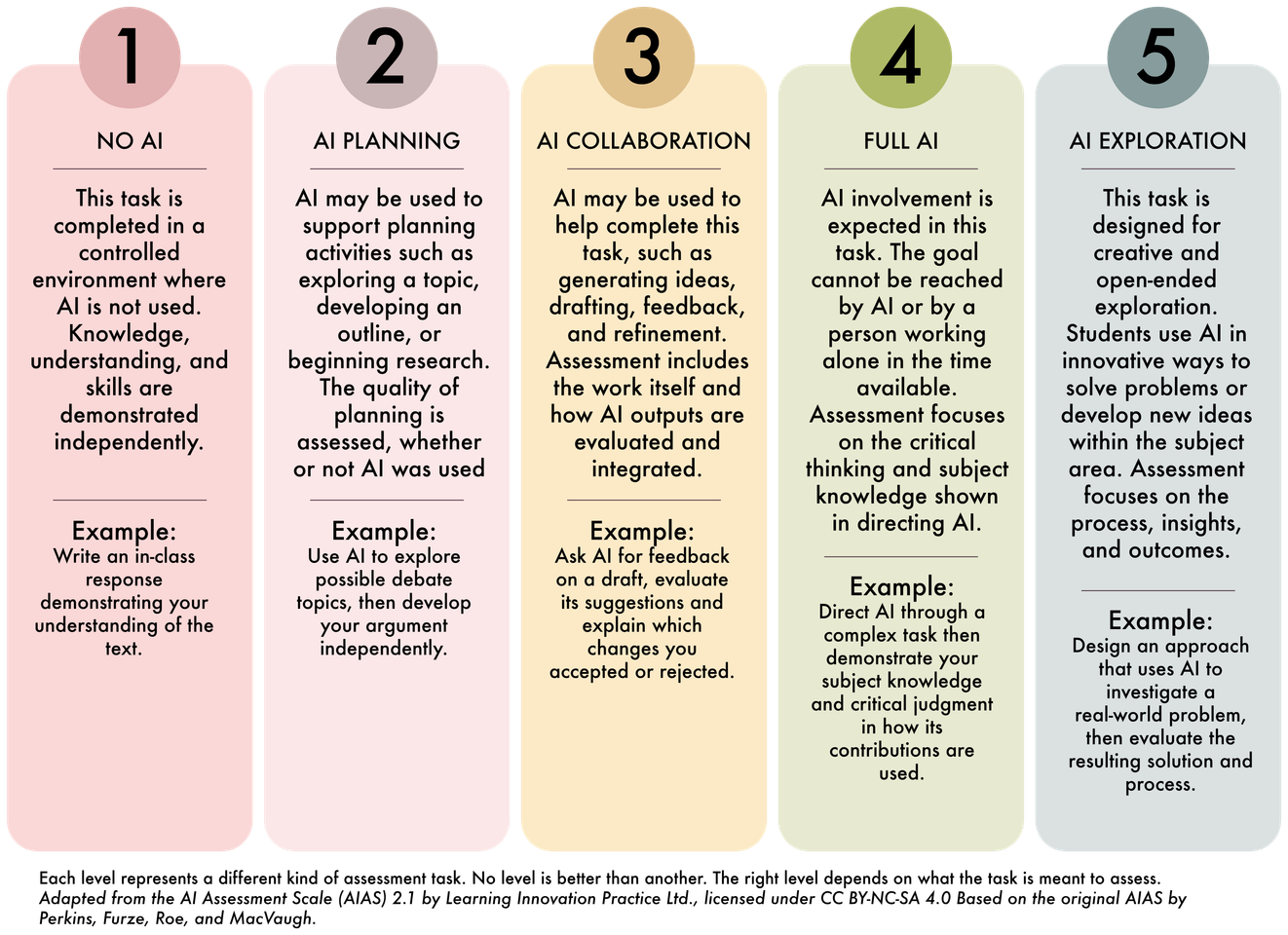
Choosing a level is only the beginning. The AIAS encourages educators to start with the learning outcomes, decide what role AI should play, consider what evidence students need to provide, and make sure the assessment criteria reflect those expectations. The important part isn't finding the "right" category. It is making the expectation clear before students begin.
Putting It Into Practice
Now, how would you apply this thinking in your own classroom? Imagine your students are completing a written assignment. How would you approach each of the following uses of generative AI? For each example, consider whether you would allow it, allow it with conditions, or not allow it for this particular assignment.
There aren't necessarily right or wrong answers. Consider the learning goal as you decide whether you would allow it, allow it with conditions, or not allow it.
Citation, Attribution & Transparency
Once expectations for AI use are clear, students also need to know how to give credit and be transparent about the sources and tools that contributed to their work. That might mean citing where information or ideas came from, acknowledging how AI was used, and taking responsibility for the final work. While these practices are closely connected, they each serve a different purpose.
From Policy to Practical Guidelines
Because generative AI continues to change quickly, educators may encounter both formal school policies and more adaptable AI guidelines. These guidelines can turn broader expectations around academic integrity, privacy, and technology use into practical instructions students can follow.
Across Canada, some school boards are developing guidance that puts these ideas into practice. While the details vary, the examples below share a similar emphasis on making expectations clear and being transparent about how AI contributed to student work.
Explore the examples below to see how different Canadian school boards are approaching AI disclosure and attribution.
For students in Grades 7–12, York Region District School Board asks students to follow their teacher's instructions about when and how AI may be used. When AI contributes to their work, students are expected to disclose and cite its use and may also be asked to explain what they used AI for, how they evaluated or modified its response, and how the final work reflects their own thinking.
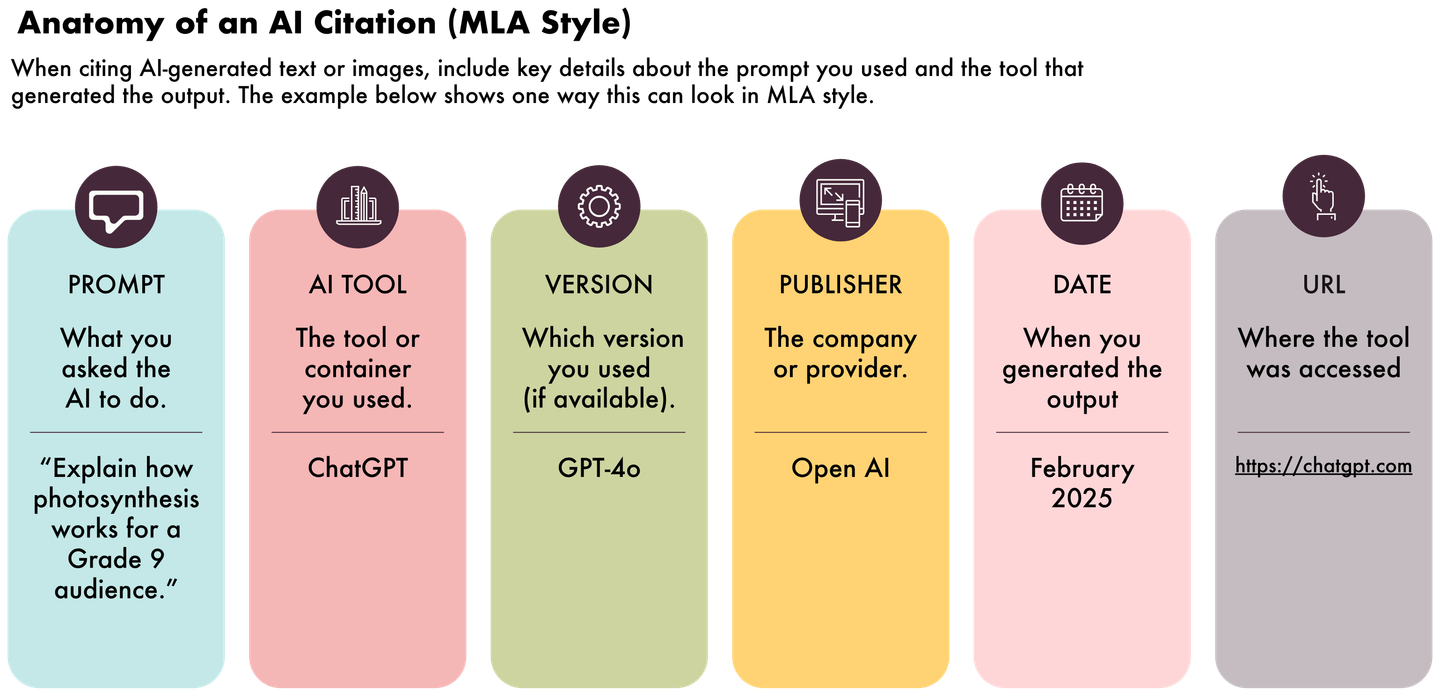
What Can an AI Citation Look Like?
There isn't one right way to document AI use. School divisions may develop their own guidelines, and citation practices can also vary depending on the style being used. What matters is that students understand the expectations they are being asked to follow and have practical examples to guide them.
The example below builds on guidance from West Vancouver Schools and shows one approach to citing AI-generated content using MLA style.
AI Citation and Source Citation Serve Different Purposes
Citing or acknowledging an AI tool makes AI's role in the work transparent, but it doesn't necessarily tell the reader where the information in its response originally came from. For example, a student might ask a generative AI tool to explain the causes of climate change. They could acknowledge that they used AI, but they should still find and consult reliable sources that support the claims they decide to include in their work. In other words, acknowledging AI doesn't replace the need to identify and cite the sources that support the information being used.
From Attribution to Copyright
There is one more distinction students may encounter. Citation tells others where material came from, but it doesn't automatically give someone the right to use that material in any way. Copyright also shapes how protected material can be copied, shared, or adapted.
In Canada, fair dealing allows certain uses of copyright-protected material for purposes that include education when the use is considered fair (Canadian Intellectual Property Office, n.d.; Council of Ministers of Education, Canada [CMEC], n.d.). Using AI doesn't remove these considerations. Students still need to think about the sources and protected materials they use, even when AI is part of how they find or work with that content.
Fostering Authentic Student Ownership
Generative AI can contribute to many parts of a student's work, but students still need opportunities to recognize their own contribution and take responsibility for what they submit. Authentic ownership doesn't necessarily mean that every word must be produced without assistance. Students have always learned with support from educators, peers, editors, dictionaries, calculators, search engines, and other tools. AI adds a new and unusually capable form of assistance to that landscape.
What matters is whether students remain meaningfully involved in the work. Can they explain the choices they made? Can they describe how their thinking changed? Can they identify where AI helped and where they disagreed with it? Can they explain the reasoning behind the final ideas?
Assignments can make that ownership more visible by asking students to reflect on their process, discuss meaningful decisions, preserve selected stages of their work, or explain how and why they used AI. The goal isn't to make students prove that AI never touched their work. It's to create opportunities for their thinking, judgment, and contribution to remain visible.
As generative AI becomes part of how students learn and create, academic integrity is about more than determining whether a tool was used. Clear expectations, open conversations, responsible attribution, and opportunities for students to demonstrate their learning can help keep responsibility and ownership with the learner.
Let’s See What You’ve Learned!
Chapter 3 has shifted the focus from how AI works to what responsible use requires. This knowledge check brings together the risks, responsibilities, and safeguards we’ve explored, and asks you to apply them to situations educators may encounter in practice.
Question 1 of 10
How can algorithmic bias affect an AI system?
What’s Next in Your Learning Journey?
In Chapter 4, we’ll shift from understanding the risks and realities of AI to considering what thoughtful use can look like in practice. We’ll explore how educators can evaluate where AI may support teaching and learning, make intentional choices about when and how to use it, and apply the safeguards and professional judgment developed throughout this chapter.