Chapter 3: Risks and Realities
Impact of Cognitive Offloading
Impact of Cognitive Offloading
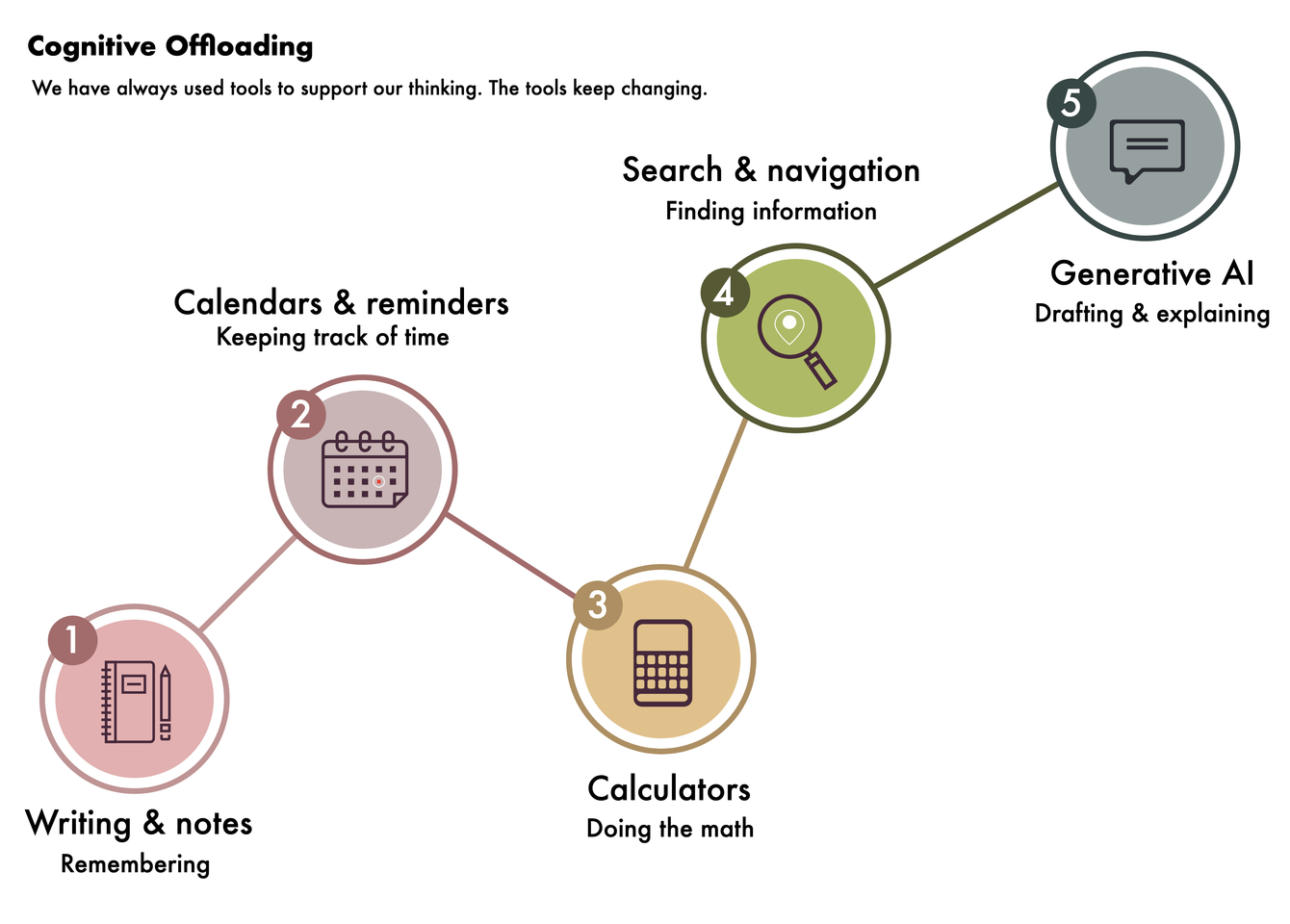
Have you ever written something down because you didn't want to forget it? Added an appointment to your calendar? Or used a calculator instead of working out a math problem on your own? If so, you've already experienced cognitive offloading.
Cognitive offloading happens when we use something outside our own minds to reduce the mental effort required for a task. These tools allow us to shift some of the work that might otherwise rely on our attention or memory into the world around us (Hu et al., 2019; Morrison & Richmond, 2020). Cognitive offloading isn't new, and it isn't necessarily a bad thing. But there are trade-offs. For example, research suggests that when people expect information to remain available externally, they may be less likely to remember the information itself (Morrison & Richmond, 2020).
Generative AI expands what cognitive offloading can look like. Unlike a calendar that remembers a date or a calculator that performs a calculation, AI can summarize information, explain concepts, draft writing, solve problems, and generate ideas. As these tools become more capable, how we choose to offload our thinking matters. AI can help manage cognitive demands, but it can also take over parts of a task that learners may benefit from working through themselves. So, when does using AI support learning, and when might it take over thinking that students need to practise themselves?
Cognitive Extension and Atrophy
The impact of AI depends a lot on what we hand over to it and what we continue doing ourselves. AI can extend our thinking by helping us work with information in new ways. A student might use it to explore different explanations of a difficult concept, generate questions that push their thinking further, or get feedback they can evaluate and respond to. Used this way, and with clear pedagogical purpose, emerging research suggests AI can support the thinking process rather than simply replacing it (Bushnell & Harrison, 2025). Additionally, according to the OECD/EU AI Literacy Framework (2026), “AI also holds particular promise for inclusion, as it can provide differentiated and individualised support for learners with special educational needs or disabilities” (p. 13).
But the same AI can also make it easier to skip important parts of the thinking process. If AI generates the ideas, organizes the argument, and writes the response, a student may arrive at a finished product while doing less of the mental work involved in getting there, which can lead to weakening critical thinking. Researchers are increasingly exploring how AI can make certain tasks easier while also reducing opportunities to practise the cognitive skills involved in completing them (Chen et al., 2025; Chirayath et al., 2025).
Ultimately, evidence supporting GenAI’s effectiveness for learning is mixed. But what is clear is that its impact largely depends on how it is used.
A Closer Look at the Study
The researchers observed differences in neural connectivity, recall, and reported ownership between participants using ChatGPT and those writing with a search engine or without external tools.
However, differences in brain activity do not necessarily mean differences in learning or thinking ability. Researchers have since pointed out that these patterns could also reflect differences in attention, motivation, or how participants approached the task (Stanković et al., 2026).
What can we take from this?
The MIT study raises useful questions about what can happen when AI takes on parts of a task that would otherwise require us to generate, organize, or recall ideas ourselves. It does not demonstrate that using ChatGPT causes poorer memory or reduces a person's ability to think.
Research into generative AI, memory, and mental effort is still developing. How someone uses AI may matter just as much as whether they use it at all. Using a tool to generate an entire response, for example, may involve different cognitive processes than questioning its suggestions, comparing alternatives, revising an output, or using it after developing your own ideas (Chen et al., 2025; Kosmyna et al., 2025). Emerging studies are beginning to investigate these differences, but there is still much we don't know.
The Illusion of Understanding
Have you ever read an explanation, thought “That makes sense,” and then struggled to explain the same idea later? Something feeling clear in the moment isn't always the same as being able to use that knowledge yourself. This distinction has long been relevant in education, and it becomes especially interesting when we introduce generative AI.
One way educators have thought about different kinds of learning is through Bloom's Revised Taxonomy. It describes learning through six processes: remember, understand, apply, analyze, evaluate, and create. The use of active verbs emphasizes what learners are able to do with their knowledge, from recalling and explaining information to applying, evaluating, and creating with it (University of Waterloo, n.d.).
Different Ways of Working With Knowledge
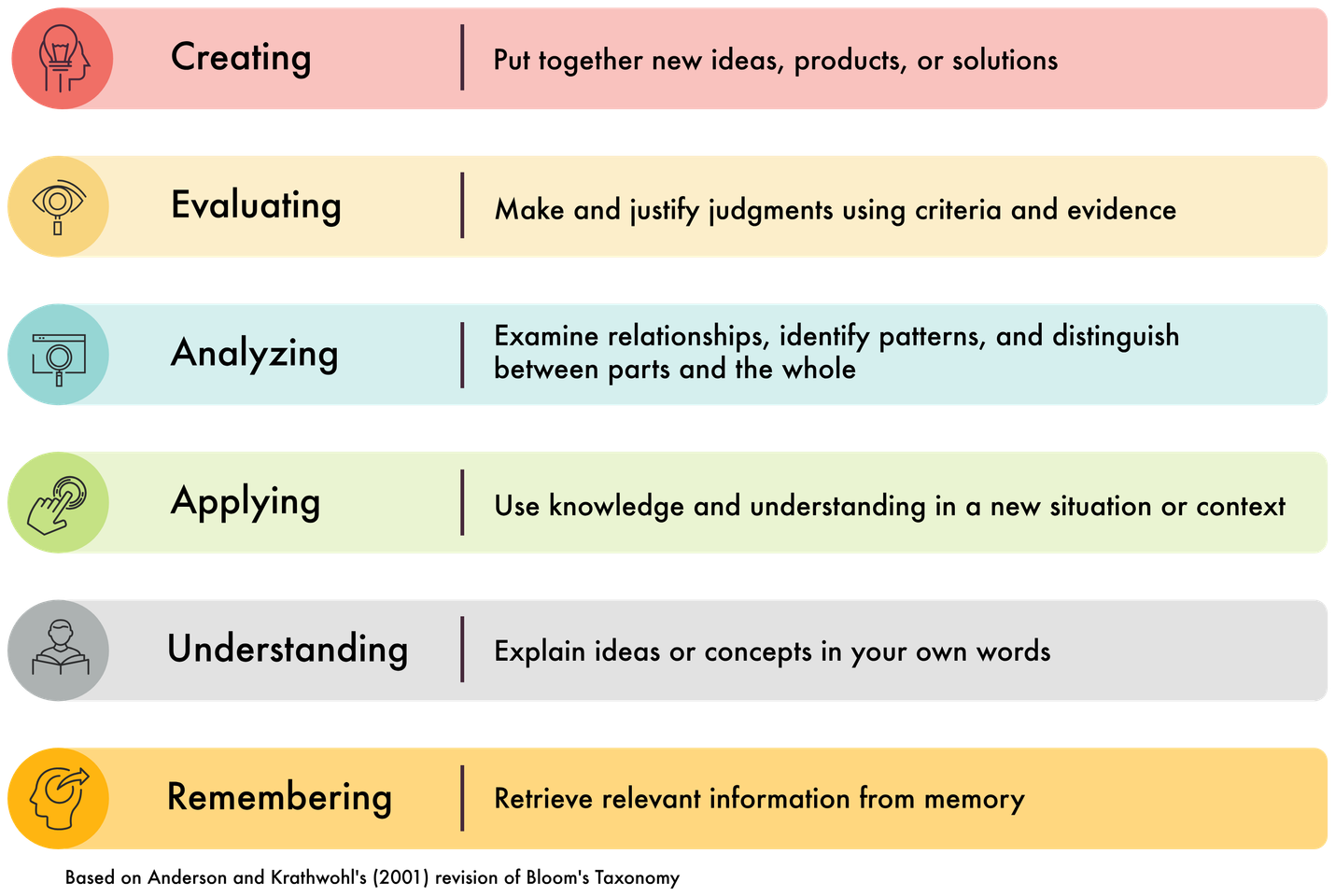
This idea shows up in curricula across Canada. While the language varies by province and territory, students are often expected to actively use and demonstrate what they know. Here's how that takes shape across the country.
How Learning Takes Shape Across Canada

British Columbia
Key curricular components: Thinking, communication, personal and social competencies, and literacy across subjects.
Explore:
Alberta
Key curricular components: Applying knowledge, critical thinking, creativity, communication, and personal growth and well-being.
Explore:
Saskatchewan
Key curricular components: Thinking, identity and interdependence, literacies, and social responsibility.
Explore:
Manitoba
Key curricular components: Indigenous ways of knowing, being, and doing, global competencies, multiliteracies, and relationships.
Explore:
Ontario
Key curricular components: Transferable skills, cross-curricular learning, and applying knowledge across subjects.
Explore:
Québec
Key curricular components: Developing competencies and mobilizing knowledge within Québec's cultural and social context.
Explore:
New Brunswick
Key curricular components: Lifelong competency development, learner agency, and real-world application of knowledge.
Explore:
Nova Scotia
Key curricular components: Higher-order thinking, interdisciplinary connections, problem solving, and demonstrating learning.
Explore:
Prince Edward Island
Key curricular components: Critical thinking, creativity, cultural understanding, environmental stewardship, and community responsibility.
Explore:
Newfoundland and Labrador
Key curricular components: Applying knowledge in meaningful contexts, diverse perspectives, and Indigenous ways of knowing.
Explore:
Yukon
Key curricular components: Critical and creative thinking, experiential learning, and Yukon First Nations ways of knowing, doing, and being.
Explore:
Northwest Territories
Key curricular components: Knowing, doing, and understanding, alongside Dene and Inuit knowledge and worldviews.
Explore:
Nunavut
Key curricular components: Inuit Qaujimajatuqangit, language, land, relationships, inquiry, and responsibility.
Explore:
Taken together, these examples show that learning across Canada is about more than understanding or remembering information. While each province and territory approaches learning within its own context, we see students being asked to think, communicate, create, make connections, apply knowledge, engage with different perspectives, and participate in the world around them.
Generative AI adds a new dimension to this. An AI-generated explanation can make a difficult concept feel remarkably easy to follow. A student might read it and think, “Okay, I get it.” But understanding an explanation in the moment isn't necessarily the same as being able to work with that knowledge independently. Can the student explain the idea in their own words? Connect it to something else? Question it? Apply it in a new context? Use it to create or solve something?
AI can support access to information and help learners make sense of difficult ideas, but those are only parts of learning. Students still need opportunities to think with what they know, make it their own, and use it in meaningful ways.
Balancing AI and Mental Effort
There is immense value in the productive struggle that comes with learning. Working through challenging problems, retrieving information, making mistakes, and developing ideas independently are all important parts of building knowledge and understanding. Educational research has long demonstrated the value of these processes. For example, retrieval practice can support learning and retention (Moreira et al., 2019), while attempting a problem before receiving direct instruction can help learners make better use of the support that follows (Chowrira et al., 2019).
Generative AI can provide explanations, suggestions, feedback, and even complete answers almost instantly. While this support may be useful in some contexts, it can also allow students to bypass the very thinking processes that contribute to meaningful learning. Choosing to integrate AI in teaching and learning requires being intentional about how students engage with it, and considering not only what AI can help them accomplish, but also which opportunities for thinking, problem-solving, and productive struggle need to be preserved. The goal should never be to make learning effortless, but to ensure that technology, when used, supports rather than replaces the cognitive work essential to learning.
Preserving Critical Thinking and Human Agency
What might the process of preserving thinking while using AI look like? The research below offers several ways to think about that balance.
Research
Research into cognitive offloading with generative AI explores what can happen when we hand parts of our thinking over to AI. One recent framework proposes that AI can support learning when it takes on work that is peripheral to the learning goal. When AI takes over the thinking students are meant to practise and develop, however, it may work against that goal (Nakamura, 2026).
Technique
Start with the learning goal and ask: What thinking do students need to practise themselves? AI might help with peripheral tasks, while students remain responsible for the reasoning, explaining, creating, or problem-solving that the activity is designed to develop.
There isn't one right way to balance AI and mental effort. The key is to consider which process matters for the learning goal and make sure students still have opportunities to practise that skill.