Chapter 5: Student AI Literacy & Future Readiness
Fostering Student AI Literacy Across Grade Levels
Fostering Student AI Literacy Across Grade Levels
Guardrails protect students, but they aren’t enough on their own. Students will inherit a world where AI is woven into how people work, create, and make decisions. Preparing them means more than keeping them safe from AI. It means helping them understand it, question it, and build the skills that remain distinctly human.
That preparation matters because AI is reshaping the workforce, shifting career pathways, and changing which skills employers value. Students who can adapt, think critically, and exercise agency over the tools they use will be best positioned to thrive.
Yet Canadian schools are still catching up to this need. A 2026 survey of Grade 6–12 teachers found that 63.6% said their school or school board had not provided training on how to instruct students on using AI. Without that support, teachers are often left to figure out how to integrate AI literacy on their own.
Closing the AI literacy gap starts in the classroom, where this work looks different at every stage. Younger students might explore how machines learn from examples, while older students might analyze how AI-generated content is produced and evaluate its reliability. Across all grades, educators can connect these experiences to the durable skills outlined in Canada’s Skills for Success, such as problem solving, adaptability, communication, and digital skills.
Early Years
Think back to Chapters 1 and 2. We explored how AI models learn from data, how training data shapes what they recognize and what they miss, and how patterns become predictions that can influence what happens next.
These ideas aren’t too complex for young students. Every day, they spot patterns, sort objects, and follow rules, so educators can introduce the same concepts through activities already happening across the curriculum, without screens or technical vocabulary. These activities can also give way to early conversations about fairness, representation, and human responsibility.
Where in your own classroom are students already spotting patterns, sorting, or following rules, and how could those moments become early lessons about AI?
Classroom Activity: Students extend a pattern of shapes or colours and write down the rule they used. A partner follows only the written rule, and the class spots where the rule was unclear or the pattern was changed.
AI Concept It Builds: Patterns, rules, and error. AI finds patterns in data and uses them to make predictions. When instructions are unclear or the data is incomplete, results can be wrong, so people need to check them.
OECD/European Union AI Literacy Framework Connection:
- Knowledge: The Nature of AI, 1.2
- Skills: Computational Thinking and Communication
- Attitudes: Curious and Reflective
These examples demonstrate how everyday classroom activities can help students understand what happens beneath the surface of AI systems, and how the same activities can spark early ethical conversations about bias and representation.
Middle Years
Middle years students are ready to move from noticing patterns to building them. By training simple models themselves, students experience how training data shapes what a model recognizes and what it misses. When students change the data and watch the results change, they see that AI outputs are not magic. They are the product of human choices about what to collect, how to label it, and who is included.
The following learning activities work across subject areas, and most can be done with unplugged or free, no-code tools that don’t require students to share personal information, such as Google Teachable Machine for image classification, Machine Learning for Kids for sentiment analysis, and Google Sheets or Excel for graphing and lines of best fit.
Classroom Activity: Students plot a small dataset, draw a line of best fit, then add outliers or remove data points and compare how the line of best fit changes.
AI Concept It Builds: Training data and model reliability. AI models make predictions by finding patterns in data, just like the line of best fit. Small, skewed, or incomplete data can produce unreliable predictions, so people need to check how much to trust a model and keep oversight of its use.
OECD/European Union AI Literacy Framework Connection:
- Knowledge: The Nature of AI, 1.2
- Skills: Critical Thinking and Computational Thinking
- Attitudes: Reflective and Responsible
As students test, question, and explain how models behave, they build skills that extend well beyond any single tool. They learn to evaluate evidence, spot assumptions, communicate findings, and judge how far a system can be trusted. These habits prepare students for the senior years, where they can apply the same critical lens to complex AI systems, investigate their societal and environmental impacts, and use what they know to solve real-world problems.
Senior Years
By high school, students have the foundations of how models learn from data, how choices shape results, and how bias enters a system. Now they can turn that lens on the complex AI systems they encounter every day and ask bigger questions: How are these systems built and maintained? What do they cost communities and the environment? How are they reshaping the careers I may be considering?
Classroom Activity: Students use publicly reported estimates of the energy needed to run an AI tool, then calculate the energy for one request, for a classroom, and for millions of daily users. They convert units, use scientific notation, and compare the totals with everyday references, such as a household’s yearly electricity use. They then change one assumption, such as the number of users, and see how the results shift.
AI Concept It Builds: Scale and environmental cost. AI systems run on large data centres that use real energy. Estimates depend on assumptions, so people question the numbers and weigh benefits against costs.
OECD/European Union AI Literacy Framework Connection:
- Knowledge: The Nature of AI, 1.5
- Skills: Self and Social Awareness and Critical Thinking
- Attitudes: Responsible and Reflective
Across these learning activities, students follow a similar cycle of defining a real problem, investigating how AI might help, creating or proposing a solution, and reflecting on who is affected. Along the way, they develop skills that are valuable beyond AI, including innovating, weighing evidence, communicating recommendations, and adapting as technologies and careers change. These are the habits that help young people shape how AI is used rather than just responding to it.
Notice that none of these learning activities required a new unit plan or curriculum outcome. Each example is aligned to the work students are already doing in language arts, math, science, and social studies. That is pivotal, and it’s where we turn next.
Cross-Curricular Integration Strategies
So far, we’ve looked at potential AI learning activities subject by subject. Cross-curricular integration goes a step further. It addresses learning outcomes from more than one subject within a single lesson or activity. This also reflects how competencies shared across Canadian curricula, such as critical thinking, problem solving, communication, collaboration, and global citizenship, are developed across subjects rather than within a single subject area (CMEC, 2018).
Consider the Language Arts example in the middle years subtopic. Students label short sentences or reviews as positive or negative to train a simple model, then test and retrain it. One project can meet learning outcomes across subject areas, as demonstrated in the following diagram.
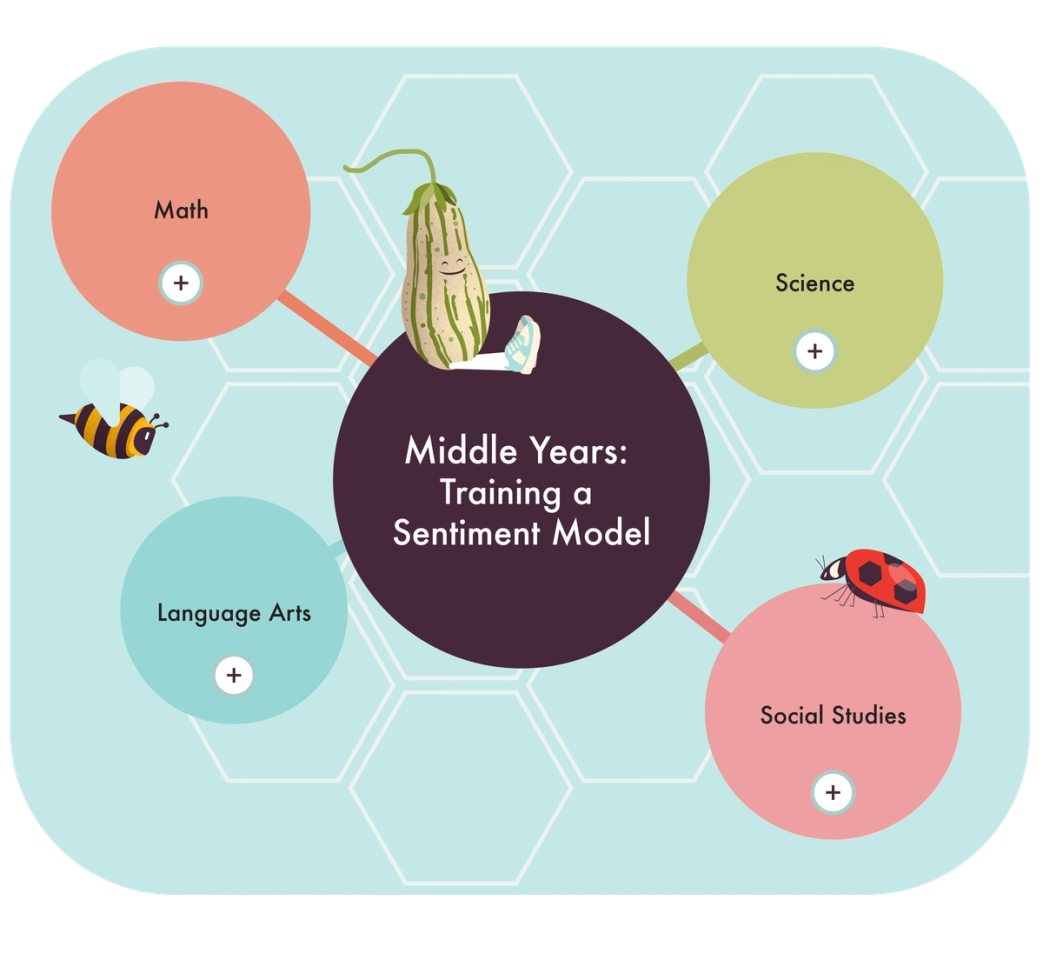
Language Arts
Analyze tone, word choice, and ambiguity while labelling
Math
Calculate accuracy and graph results before and after changing the data
Science
Change one variable, the training data, and gather evidence of its effect
Social Studies
Ask whose voices are in the data and whose are missing
To design your own cross-curricular lesson:
- Start with Outcomes: Identify outcomes from two or more subjects that one task could meet.
- Choose an Authentic Question: Real community issues naturally draw on several subjects.
- Keep Subject Outcomes Primary: AI is the lens, so students still meet each subject’s expectations.
The OECD/European Union AI Literacy Framework
Looking for more ideas? The OECD/European Union’s Empowering Learners for the Age of AI: An AI Literacy Framework for Primary and Secondary Education (2026) defines the competences students need across four domains: Engage with AI, Create with AI, Manage AI, and Shape AI. It also includes practical classroom examples that show what AI literacy can look like at different stages of schooling. Use it as a companion resource as you adapt the activities in this section to your own grade level and subject area.
Strategies for Discussing Safety & Well-Being
In Chapters 3 and 4, we touched on anthropomorphic AI and considerations for safeguarding student identity and well-being. You now know these are important topics, so how do you discuss them with students and how can you integrate these teachings across subject areas?
Some organizations have developed a number of grade-level specific lesson plans with accompanying resources to help teach difficult AI concepts to students. These range from deep dives into cyberbullying and online harms to AI chatbots and friendship. When considering cross-curricular connections, apply the strategies noted above, drawing connections to cross-curricular competencies while keeping subject outcomes primary.